
Table of Contents
ToggleMost homeowners don’t realize that Albert Einstein, the man behind the theory of relativity, also invented a refrigerator back in 1926. And it wasn’t just a science experiment. Einstein’s refrigerator ran without electricity, used no harmful refrigerants, and operated on nothing but a heat source and a few clever thermodynamic principles. A century later, that same design is sparking renewed interest as DIYers and eco-conscious homeowners search for sustainable, off-grid alternatives to the compressor-based fridges humming in nearly every kitchen. While it might sound like vintage tech, Einstein’s approach to cooling is more relevant today than ever, especially as energy costs rise and environmental regulations tighten around synthetic refrigerants.
Key Takeaways
- Einstein’s refrigerator uses absorption cooling powered by heat and ammonia rather than electricity and compressors, making it an eco-friendly alternative to modern refrigeration.
- The Einstein refrigerator design produces zero ozone depletion and negligible greenhouse gas emissions, unlike conventional models using synthetic refrigerants.
- Absorption refrigeration works best in off-grid, solar-powered, or waste-heat recovery scenarios where conventional compressor fridges would be impractical or expensive.
- Building a DIY Einstein refrigerator requires HVAC expertise, refrigerant certification, and precision metalworking—commercial units from brands like Dometic offer safer, warrantied alternatives.
- Modern applications including solar-thermal cooling and propane-powered absorption units prove that Einstein’s 1926 innovation remains viable for remote cabins, RVs, and homes seeking energy independence.
What Is the Einstein Refrigerator and How Does It Work?
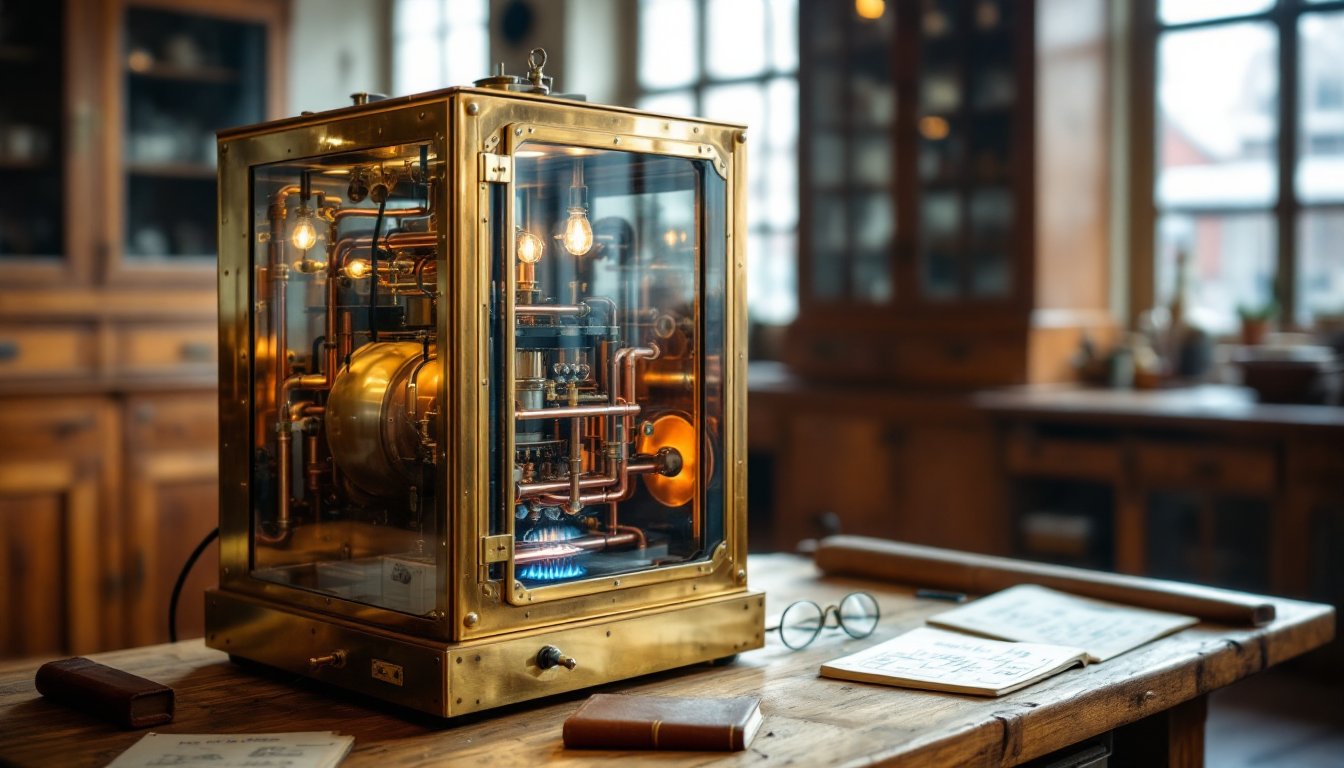
Einstein’s refrigerator is an absorption refrigerator that uses heat, not mechanical compression, to create a cooling effect. Unlike the vapor-compression cycle in modern fridges (which relies on a compressor, condenser, and electric motor), Einstein’s design uses a heat source, ammonia, water, and butane in a closed-loop system with no moving parts.
Here’s the basic process:
- Heat is applied to a generator chamber containing ammonia dissolved in water.
- The heat drives ammonia gas out of the solution and into a condenser.
- In the condenser, ammonia cools and liquefies.
- The liquid ammonia enters an evaporator chamber, where it absorbs heat from the fridge interior, creating the cooling effect.
- The ammonia gas then recombines with water in an absorber, and the cycle repeats.
The beauty of this design? It runs on any heat source: gas flame, solar heat, even waste heat from another appliance. There’s no compressor cycling on and off, no electric motor, and no synthetic refrigerants like R-134a or R-410A that can contribute to ozone depletion or global warming.
Einstein co-invented this system with his former student, physicist Leó Szilárd, in response to news reports of refrigerant leaks causing deaths in European homes. Their goal was safety and simplicity, a fridge that wouldn’t explode, leak toxic gases, or require grid power. They filed the patent in 1926, and several models were built, though the design never reached mass production.
The Fascinating History Behind Einstein’s Cooling Innovation
In the 1920s, home refrigeration was still a risky proposition. Early models used methyl formate, sulfur dioxide, or ammonia as refrigerants, all of which could leak, cause fires, or poison families in their sleep. After a Berlin family died from a refrigerant leak in 1926, Einstein and Szilárd set out to create a safer alternative.
Their invention wasn’t Einstein’s first foray into practical engineering. He’d already co-developed an electromagnetic pump and held patents on camera technology. But the refrigerator was different, it addressed a real, immediate household danger.
The Einstein-Szilárd refrigerator was tested by the Swedish manufacturer Electrolux and a few German companies. Early prototypes worked, but they were bulky, slower to cool than compressor models, and harder to manufacture at scale. By the 1930s, safer synthetic refrigerants like Freon became available, and compressor-based fridges dominated the market. Einstein’s design was shelved.
Fast-forward to the 21st century: concerns about climate change, refrigerant regulations (like the EPA’s phasedown of hydrofluorocarbons), and the quest for off-grid appliances have brought absorption cooling back into the spotlight. Researchers at Oxford University even rebuilt a working Einstein refrigerator prototype in 2008, proving the concept still holds up nearly a century later.
Why Einstein’s Refrigerator Is More Relevant Today Than Ever
Environmental Benefits for Eco-Conscious Homeowners
Modern refrigerators are among the top energy consumers in most homes, accounting for roughly 7–8% of total household electricity use. They also rely on chemical refrigerants that, if leaked or improperly disposed of, contribute to greenhouse gas emissions. The EPA has been phasing down HFCs since 2022, and some states (like California) have even stricter timelines.
Einstein’s refrigerator sidesteps these issues entirely. It uses ammonia and butane, both naturally occurring substances with minimal environmental impact. Ammonia has zero ozone depletion potential and negligible global warming potential compared to synthetic refrigerants. And because the system runs on heat rather than electricity, it can be powered by solar thermal collectors, propane, or even biomass burners, making it a viable option for off-grid cabins, tiny homes, or disaster-resilient setups.
For homeowners looking to reduce their carbon footprint, an absorption fridge (whether Einstein’s original design or a modern derivative) offers a way to cool food without relying on compressor motors or coal-fired grid power. That’s a meaningful shift, especially as more jurisdictions adopt net-zero building codes.
Energy Efficiency and Cost Savings Potential
Here’s where things get nuanced. Einstein’s refrigerator doesn’t use electricity, but it does require a constant heat input, and heat isn’t free. If you’re running it on propane, you’ll trade your electric bill for a fuel bill. The efficiency comes down to what heat source you’re using and how much that costs in your region.
Where absorption fridges shine:
- Off-grid or solar-thermal setups: If you have excess heat from a wood stove, solar hot water system, or biogas digester, you can essentially cool your food for free.
- RVs and remote sites: Propane-powered absorption fridges are common in RVs, boats, and hunting camps. They’re silent, reliable, and don’t drain batteries.
- Waste heat recovery: Industrial or commercial settings with waste heat can use absorption chillers to offset cooling loads without added energy input.
Where they fall short:
- Grid-tied homes with cheap electricity: If you’re paying 12 cents per kWh and have access to an Energy Star–rated compressor fridge, running an absorption unit on propane or electric resistance heat will likely cost more over time.
- Cooling speed: Absorption fridges are slower to pull down temperature. Expect a 24- to 48-hour cooldown period when first starting up, versus a few hours for a compressor model.
For cost savings, the math depends on fuel prices and your specific use case. But for resilience, keeping food cold during a power outage or in a location without grid access, Einstein’s approach is hard to beat. Some modern Einstein refrigerator models are being re-engineered to optimize heat sources and improve efficiency, making them more practical for everyday homeowners.
Modern Applications and DIY Possibilities for Your Home
Can you build an Einstein refrigerator in your garage? Technically, yes, but it’s not a weekend project. The system requires precision welding, pressure testing, and handling ammonia gas, which is corrosive and toxic in high concentrations. You’d also need:
- Steel or copper tubing (leak-free joints are critical)
- A heat source with adjustable output (gas burner or electric element)
- Ammonia, butane, and distilled water in exact ratios
- A well-ventilated workspace and appropriate PPE (goggles, gloves, respirator)
Unless you have experience with HVAC systems, refrigerant handling (EPA Section 608 certification), and metalworking, this isn’t a beginner DIY. Leaking ammonia can cause burns, respiratory distress, and even explosions if ignited. If you’re serious about building one, partner with someone who holds refrigerant and pressure vessel credentials, or treat it as a learning project with professional oversight.
That said, commercially available absorption refrigerators use the same thermodynamic principles Einstein pioneered. Brands like Dometic and Norcold make propane-powered models for RVs and off-grid cabins. These units are UL-listed, warrantied, and designed for safe operation. If you’re outfitting a tiny home, solar cabin, or emergency shelter, a modern absorption fridge with smart features offers the reliability of Einstein’s concept without the DIY risk.
Another angle: solar-thermal cooling. Some homeowners are experimenting with parabolic solar collectors or evacuated tube arrays to generate the heat needed to drive an absorption cycle. This setup works best in sunny climates (Southwest US, Mediterranean regions) and requires a thermal storage tank to smooth out day-night cycles. It’s advanced DIY territory, but if you’re already running a solar hot water system, adding an absorption chiller for a small fridge or beverage cooler is feasible with the right components.
If you’re weighing whether to invest in an absorption unit, a practical buying guide can help you compare models, sizing, and fuel options. Key considerations include interior capacity (measured in cubic feet), BTU input for the burner, and whether the unit offers dual-fuel capability (propane and AC power for flexibility).
Conclusion
Einstein’s refrigerator isn’t just a historical curiosity, it’s a proven technology that’s finding new life in an era obsessed with sustainability, resilience, and off-grid living. Whether you’re planning a remote cabin, prepping for grid instability, or simply exploring alternatives to compressor-based cooling, absorption refrigeration offers a silent, reliable, and environmentally friendly option. Just remember: this isn’t plug-and-play. Evaluate your heat source, your budget, and your technical comfort level before diving in. And if you’re not ready to go full Einstein, even a propane backup fridge can be a smart addition to your home’s emergency toolkit.