
Table of Contents
ToggleFinding the right small kitchen table and chairs isn’t just about saving floor space, it’s about creating a functional dining area that actually works for how you live. Whether you’re furnishing a studio apartment, a galley kitchen, or a breakfast nook carved out of a corner, the right setup can make a cramped space feel intentional instead of claustrophobic. The market’s flooded with options labeled “space-saving,” but not all compact tables are created equal. Some wobble, some block traffic flow, and some look great in photos but eat up more room than a standard dinette once you pull the chairs out. This guide cuts through the marketing speak to help you choose small table and chairs for kitchen spaces that actually deliver on function, durability, and smart use of square footage.
Key Takeaways
- A small kitchen table and chairs must be properly sized to your space—measure clearance zones and daily users rather than defaulting to the smallest option available.
- Drop-leaf and extendable tables maximize flexibility, but invest in solid support mechanisms and annually maintain sliding joints with paraffin wax or silicone spray to prevent wear.
- Round tables optimize corner placement and traffic flow, while square tables tuck against walls and pair well with benches, making both smart choices depending on your kitchen layout.
- Counter-height tables with nesting stools save visual weight and floor space, while wall-mounted fold-down tables work best in galley kitchens and studios where even compact freestanding tables aren’t feasible.
- Choose materials based on durability and kitchen conditions—tempered glass opens sightlines, engineered wood offers stability, and quality solid wood is repairable but heavier and prone to seasonal movement.
- Minimalist Scandinavian designs with tapered legs, light finishes, and streamlined chairs keep small kitchens feeling airy instead of cramped.
Why Small Kitchen Tables Are Essential for Modern Homes
Open floor plans and rising real estate costs have made small kitchens the norm, not the exception. According to recent housing data, the average new single-family home kitchen shrank by roughly 8% between 2010 and 2025. That means dedicated dining rooms are disappearing, and the kitchen table is pulling double duty as a workspace, assignments station, and meal hub.
Small kitchen table sets solve a practical problem: they provide a defined eating area without choking off circulation space. A properly sized table lets you move around the kitchen while cooking, open the fridge door fully, and pull out chairs without banging into cabinets or doorways.
Beyond function, a well-chosen table anchors the room visually. In tight quarters, furniture that’s too large makes the space feel cluttered and dark. A table scaled to the room keeps sightlines open and can actually make a small kitchen feel larger. The key is proportion, not just picking the smallest table you can find, but choosing one that fits the room’s dimensions and your household’s actual seating needs.
Types of Small Kitchen Tables and Chairs to Consider
Not all compact tables work the same way. Understanding the core types helps narrow down what’ll function best in your layout.
Drop-Leaf and Extendable Tables
Drop-leaf tables have hinged sides that fold down when not in use, shrinking the footprint to as little as 10–12 inches deep. When you need seating, you lift one or both leaves and lock them in place with swing-out support brackets. They’re ideal for kitchens where the table sits against a wall most of the time.
Check the support mechanism before you buy. Cheaper models use flimsy gate-leg frames that rack and wobble under load. Look for tables with solid hardwood brackets or metal locking arms. The tabletop should be at least ¾ inch thick (actual dimension, not nominal) to resist sagging when the leaves are up.
Extendable tables use a center leaf or a pull-apart frame. Some store the leaf underneath the tabletop: others require you to stash it in a closet. Extendable designs work well if you host occasionally but don’t want a large table taking up space daily. The trade-off is a visible seam down the middle and potential for the mechanism to stick or misalign over time. Lubricate the slides annually with paraffin wax or silicone spray to keep them moving smoothly.
Many creative furniture modifications take budget-friendly extendable tables and customize them with new finishes, leg swaps, or added storage underneath, handy if you want a custom look without custom pricing.
Round vs. Square Tables for Tight Spaces
Round tables maximize seating in corner placements because there are no corners to snag on walls or block pathways. A 36-inch-diameter round comfortably seats three to four people and fits into nooks where a square table would feel jammed in. The curved edge also improves traffic flow, you’re less likely to catch a hip on a round table than a sharp corner.
Downside: round tables don’t push flush against walls, so they’re not ideal if you need the table out of the way when not in use. They also waste some usable surface area compared to a square of the same width.
Square tables (typically 30×30 inches or 36×36 inches) tuck neatly into corners and against walls. They’re easier to pair with benches or built-in banquettes, which can save even more space by eliminating chair clearance on one side. A 36-inch square handles four people adequately, though elbow room gets tight if everyone’s eating at once.
For truly cramped kitchens, a 30×30-inch square is the functional minimum for two people to eat comfortably without knocking elbows. Anything smaller and you’re better off with a wall-mounted fold-down table or a countertop bar.
How to Choose the Right Size for Your Kitchen
Measure twice, buy once. Start by mapping your clearance zones, not just the table dimensions.
You need 36 inches of clearance behind each chair to pull it out and sit down comfortably. If the table backs up to a low-traffic wall or a window, you can cheat that down to 30 inches, but go any tighter and you’ll be doing an awkward shimmy every time you sit.
If your kitchen has a major walkway, say, the path from the back door to the fridge, you need 42 to 48 inches of passage width when chairs are in use. Mark this on the floor with painter’s tape before you shop. Stand in the space, walk through it, open adjacent drawers and cabinets. This sounds obvious, but it’s the step most people skip.
Next, count your actual daily users. A household of two doesn’t need a four-seat table if it blocks half the kitchen. A table that seats two daily, with the option to add a leaf or a bench for guests, is a smarter call. Resist the urge to oversize “just in case.” That extra seating you use twice a year isn’t worth sacrificing everyday function.
Standard table height is 28 to 30 inches, which pairs with chairs that are 17 to 19 inches tall (floor to seat). Counter-height tables (34 to 36 inches) work well in small kitchens because the taller profile takes up less visual weight and can double as a prep surface. Pair them with stools that tuck completely underneath to free up floor space. Just make sure the stools have footrests, dangling feet get uncomfortable fast.
Space-Saving Design Features to Look For
Smart small-scale tables pack in features that stretch function without adding bulk.
Stools or chairs that nest under the table are essential if floor space is at a premium. Look for designs where the seat height and apron clearance allow the chair to slide completely underneath, ideally with an inch or two to spare. Armless chairs nest better than armed ones. Stools with square or rectangular seats often tuck in tighter than round-seated models.
Built-in storage isn’t common on small tables, but when done right, it’s a game-changer. Some designs include a shallow drawer for flatware or napkins, or a lower shelf for cookbooks or fruit bowls. Just make sure the storage doesn’t interfere with legroom. Measure the knee clearance, anything less than 24 inches from floor to the underside of the apron or drawer will feel cramped for most adults.
Wall-mounted drop tables (also called fold-down or Murphy tables) attach to the wall with heavy-duty brackets and fold flat when not in use. These are worth considering in galley kitchens or studios where even a small freestanding table eats too much space. Installation requires hitting at least two wall studs with lag screws rated for the table’s weight plus the load (figure 50 pounds per seated person as a safe estimate). If your walls are steel-framed or you’re in an apartment where stud spacing is irregular, use toggle bolts rated to 100+ pounds each. Don’t trust drywall anchors alone, they’ll pull out under repeated stress.
Several designers featured on platforms highlighting small space living ideas favor slim pedestal bases over four-leg frames. A single center pedestal eliminates corner legs that interfere with seating and legroom, letting you squeeze in an extra chair when needed. The base needs to be weighted properly, if it’s top-heavy or the pedestal diameter is too narrow, the table will tip when someone leans on the edge. A pedestal base should be at least one-third the table diameter for stability.
Materials and Styles That Work Best in Small Kitchens
Material choice affects durability, maintenance, and how heavy or bulky the table feels.
Solid wood (oak, maple, walnut) is durable and repairable. Scratches and dents can be sanded out, and a wood table can last decades if maintained. The downside is weight, a solid oak table is a bear to move, and wood expands and contracts with humidity. In a kitchen, that means seasonal gaps in drop-leaf seams or extendable joints. Seal the wood with polyurethane or a hard wax oil to resist water rings and food stains. Reapply finish every two to three years depending on use.
Engineered wood (plywood, MDF with veneer) is lighter and more stable than solid wood, and usually cheaper. Quality varies wildly. Look for tables with plywood cores at least ½ inch thick and a real wood veneer, not printed laminate. MDF is fine for light use, but it doesn’t hold up to moisture, one spilled coffee that soaks into an unfinished edge and the core swells permanently.
Metal bases (steel, aluminum, cast iron) pair well with wood, glass, or laminate tops and add an industrial or modern look. Steel tube frames are lightweight and affordable, but they can feel flimsy if the wall thickness is too thin. Look for 16-gauge steel or thicker. Cast iron is bombproof but heavy. Powder-coated finishes resist rust better than paint: inspect welds and joints for rough edges or gaps that’ll collect crumbs.
Glass tops make a small kitchen feel more open because they don’t block sightlines. Tempered glass is essential, it’s four to five times stronger than regular glass and shatters into small, dull chunks instead of shards if it breaks. Expect ¼-inch to ⅜-inch thickness for a small table. Glass shows every fingerprint and watermark, so plan on wiping it down daily. Use a microfiber cloth and a 50/50 vinegar-water mix to avoid streaks.
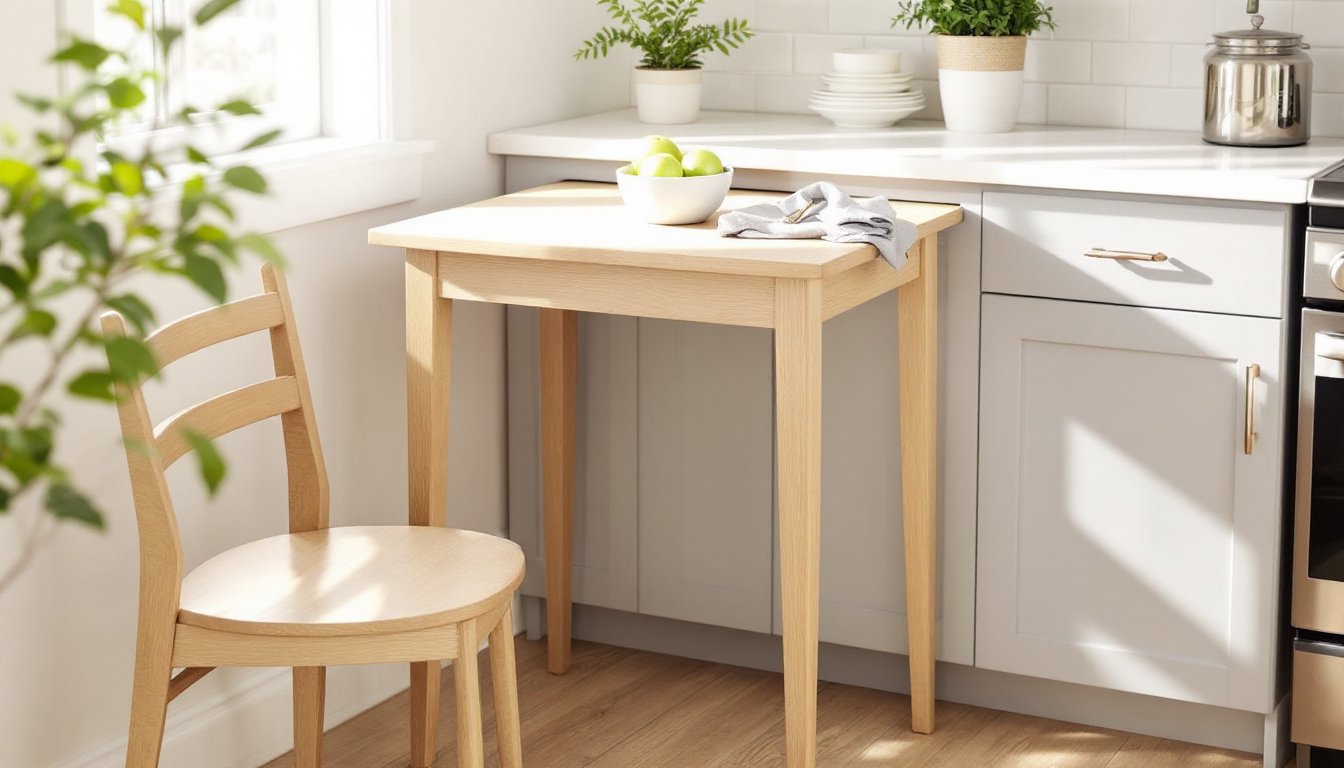
Style-wise, minimalist or Scandinavian designs with tapered legs and slim profiles work well in tight spaces. Chunky farmhouse tables with thick aprons and bulky legs eat visual space and make a small kitchen feel smaller. Stick to light or medium wood tones, or go with painted finishes in white, gray, or soft pastels to keep the room feeling airy. Dark stains can work if there’s plenty of natural light, but they tend to make small kitchens feel cave-like.
If you’re handy with tools, building your own table from free DIY furniture plans lets you customize dimensions to your exact space. A simple four-leg table with a plywood top and pine or poplar legs is a weekend project for someone comfortable with a miter saw and a drill. Just account for actual lumber dimensions, a 2×4 is actually 1½ × 3½ inches, and a 1×4 is ¾ × 3½ inches. Misreading nominal sizes is a rookie mistake that throws off your whole cut list.
Chairs should match the table’s scale. Avoid overstuffed upholstered chairs in small kitchens, they’re bulky and hard to clean. Lightweight wood or metal side chairs, ladder-backs, or molded plastic (like Eames-style shells) keep the look streamlined. If you want cushioning, go with a slim seat pad that you can remove and wash, not a thick foam back that adds three inches of bulk per chair.